Symmetry-Informed Causal Partial Identification

  PDF   Reviews   Code   Slides

Preprint 

TLDR: Partial identification (PI) aims to bound causal effects under assumptions that may not be sufficient for point-identification. We introduce known data symmetries—invariance of the causal effect under certain data transformations—as a new, underutilized source of constraints to sharpen PI bounds.


Partial Identification

Causal effects are generally not identifiable from observational data alone: hidden confounding leaves a whole set of data-generating processes consistent with what we observe. Partial identification (PI) responds by bounding the causal effect over the identified set Hpı:={h⋆q:q∈Qpı}\mathcal{H}_{\mathrm{p}\textnormal{\i}} := \{ h^q_{\star} : q \in \mathcal{Q}_{\mathrm{p}\textnormal{\i}} \}, encoding assumptions Ppı\mathcal{P}_{\mathrm{p}\textnormal{\i}} as constraints of an optimization problem. In practice, however, PI bounds are often too wide to inform decisions.

SEM with hidden confoundingdo(x) intervention
Figure 1: The observational SEM with hidden confounding (left) and the intervention of interest (right).
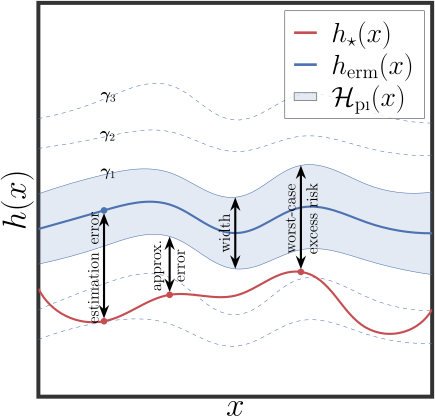
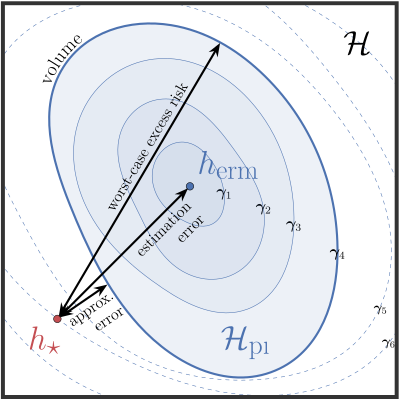
PI interval at a query pointidentified set with PI metrics
Figure 2: PI sets Hpı(x)\mathcal{H}_{\mathrm{p}\textnormal{\i}}(\boldsymbol{x}) (left) and Hpı\mathcal{H}_{\mathrm{p}\textnormal{\i}} (right) for various sensitivity parameters γ\boldsymbol{\gamma} and different metrics of interest: estimation, approximation, and worst-case errors.

Symmetry-Informed Bounds

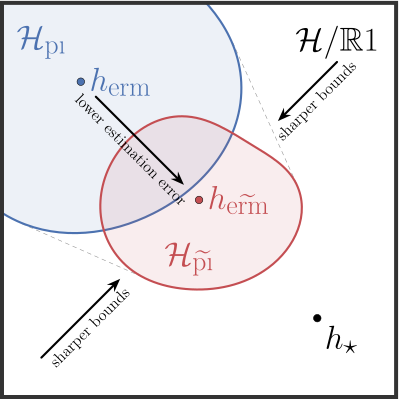
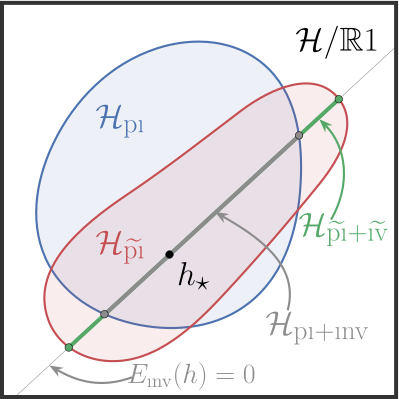
Many domains come with known symmetries T\mathcal{T}: transformations of the data under which the causal effect is invariant by design, h⋆(τx)=h⋆(x)h_{\star}(\tau \boldsymbol{x}) = h_{\star}(\boldsymbol{x}) for all τ∈T\tau \in \mathcal{T}. We show how to exploit them for PI—explicitly, by constraining candidate models to have small invariance error, or implicitly, by augmenting the data before running an off-the-shelf PI method. Both routes provably sharpen the resulting bounds.
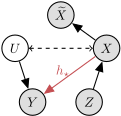
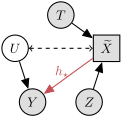
data augmentation graphsoft intervention graph
Figure 3: Data augmentation (left) acts like a soft intervention (right).
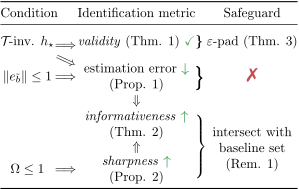
point vs partial identification under DA
Table 1: Point vs. partial identification under DA.
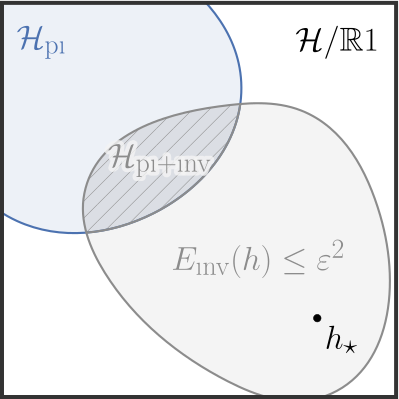
invariance-constrained identified set
(a) Hpı+ınv\mathcal{H}_{\mathrm{p}\textnormal{\i}+\textnormal{\i}\mathrm{nv}}
post-DA identified set
(b) Hpı~\mathcal{H}_{\widetilde{\mathrm{p}\textnormal{\i}}}
post-DA IV identified set
(c) Hpı~+ıv~\mathcal{H}_{\widetilde{\mathrm{p}\textnormal{\i}}+\widetilde{\textnormal{\i}\mathrm{v}}}
intersection of identified sets
(d) Hpı(x)∩(Hpı~(x)±ε)\mathcal{H}_{\mathrm{p}\textnormal{\i}}(\boldsymbol{x}) \cap (\mathcal{H}_{\widetilde{\mathrm{p}\textnormal{\i}}}(\boldsymbol{x}) \pm \varepsilon)
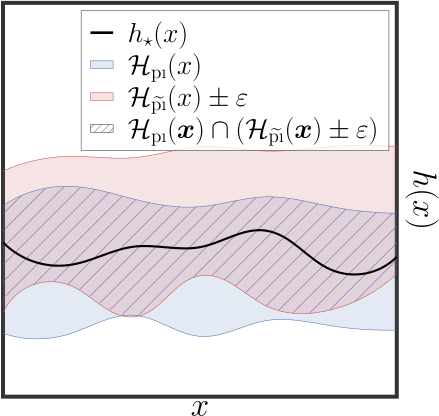
Figure 4: Identified sets under symmetry constraints: (a) explicit invariance constraints prune the baseline set; (b) DA pre-processing yields a sharper, better-centered set; (c) IV constraints enforce symmetry; (d) intersecting with the baseline set stays robust under arbitrary DA.

Experimental Results

On an optical-device benchmark, US cigarette demand data, and a do-MNIST benchmark, symmetry-informed PI stays valid while sharpening the bounds obtained by canonical PI methods.
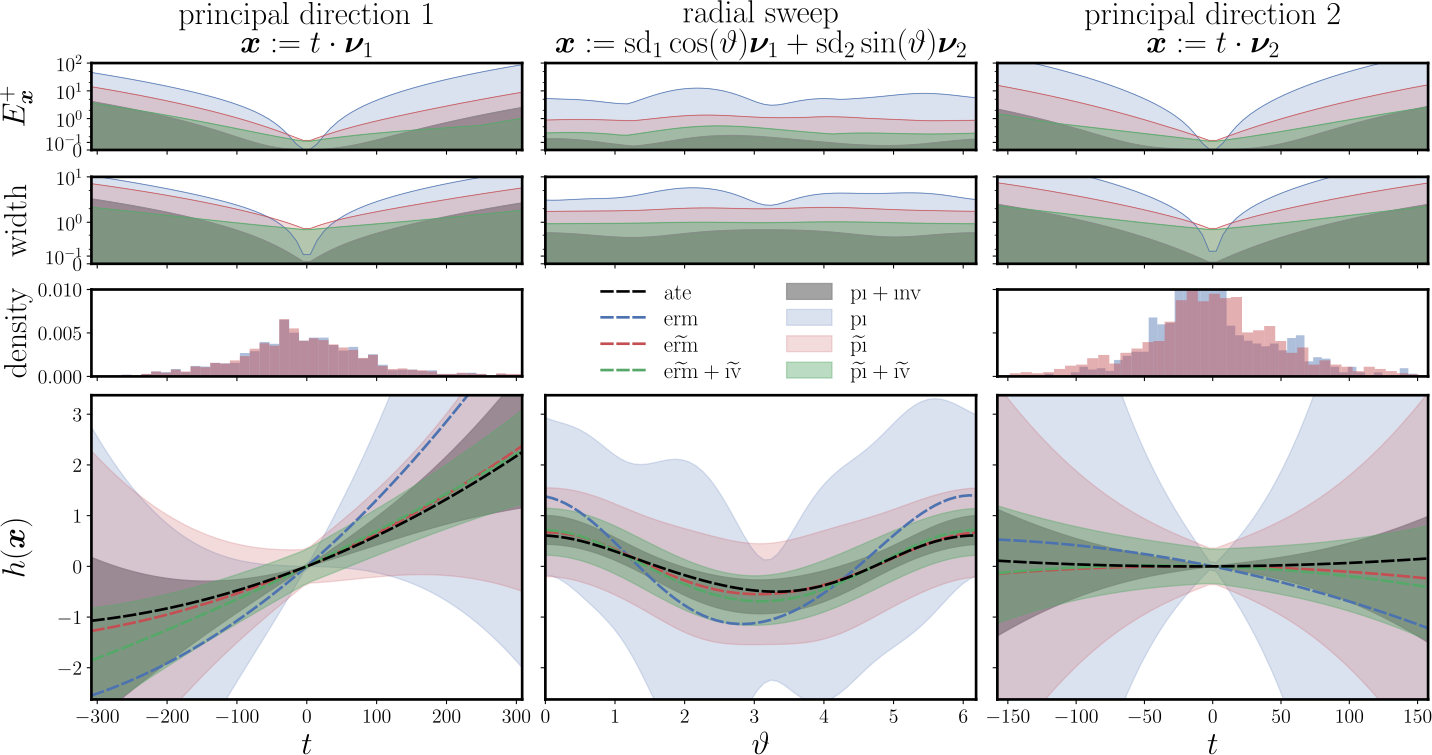
optical device query sweeps
Figure 5: Optical device. Across queries along the principal components of the inputs and a radial sweep, symmetries reduce interval width and worst-case error over baseline while maintaining validity.
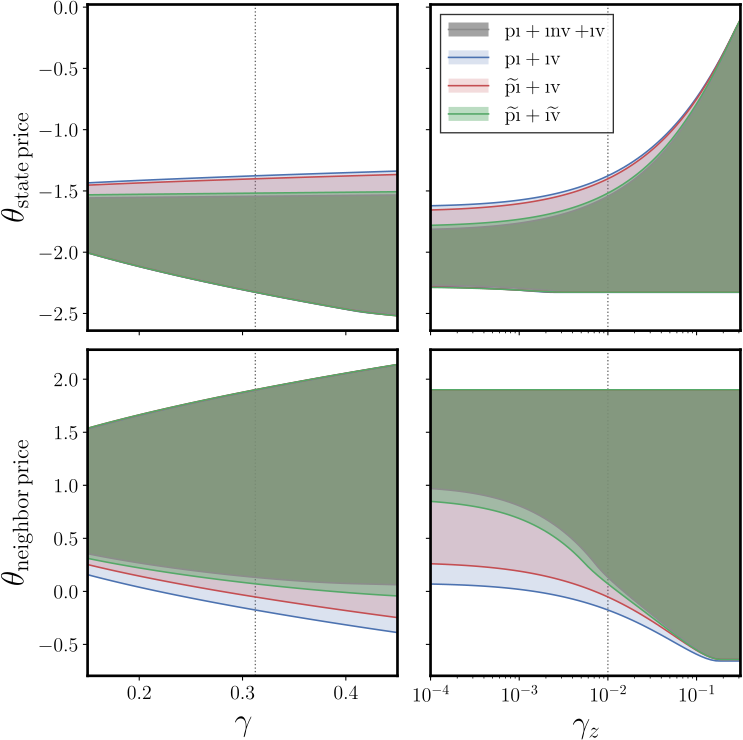
US cigarette demand price elasticity bounds
Figure 6: US cigarette demand. State (top) and neighbor (bottom) price elasticity across confounding (left) and IV (right) budgets: imposing the symmetry makes the neighbor-price effect clearly positive unless the IV is heavily leaky.
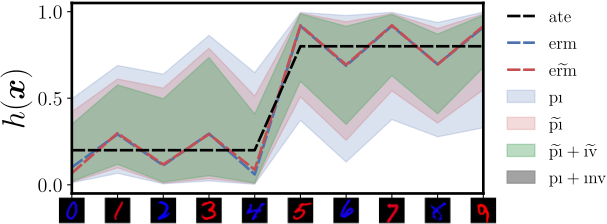
do-MNIST digit sweep
Figure 7: do-MNIST. Bounds on 10 exemplar images with alternating colors: ERM follows color, while symmetries sharpen PI.

Citation

This work extends our prior work1 on causal point-estimation with DA. A non-archival summary was also presented at the CDM workshop @ UAI 2026.2

@misc{akbar2026symmetry4CausalBounds,
      title={Symmetry-Informed Causal Partial Identification},
      author={Uzair Akbar and Zulfiqar Zaidi and Niki Kilbertus and Krikamol Muandet and Bo Dai},
      year={2026},
      eprint={2610.09230},
      archivePrefix={arXiv},
      primaryClass={cs.LG},
      url={https://arxiv.org/abs/2610.09230},
}

References

  1. Uzair Akbar, Niki Kilbertus, Hao Shen, Krikamol Muandet, and Bo Dai. An Analysis of Causal Effect Estimation using Outcome Invariant Data Augmentation. NeurIPS, 2025. ↩

  2. Uzair Akbar, Zulfiqar Zaidi, Niki Kilbertus, Krikamol Muandet, and Bo Dai. Bounding Treatment Effects with Symmetry Sensitivity Models. UAI 2026 Workshop on Causality for Decision Making, 2026. [PDF] ↩